
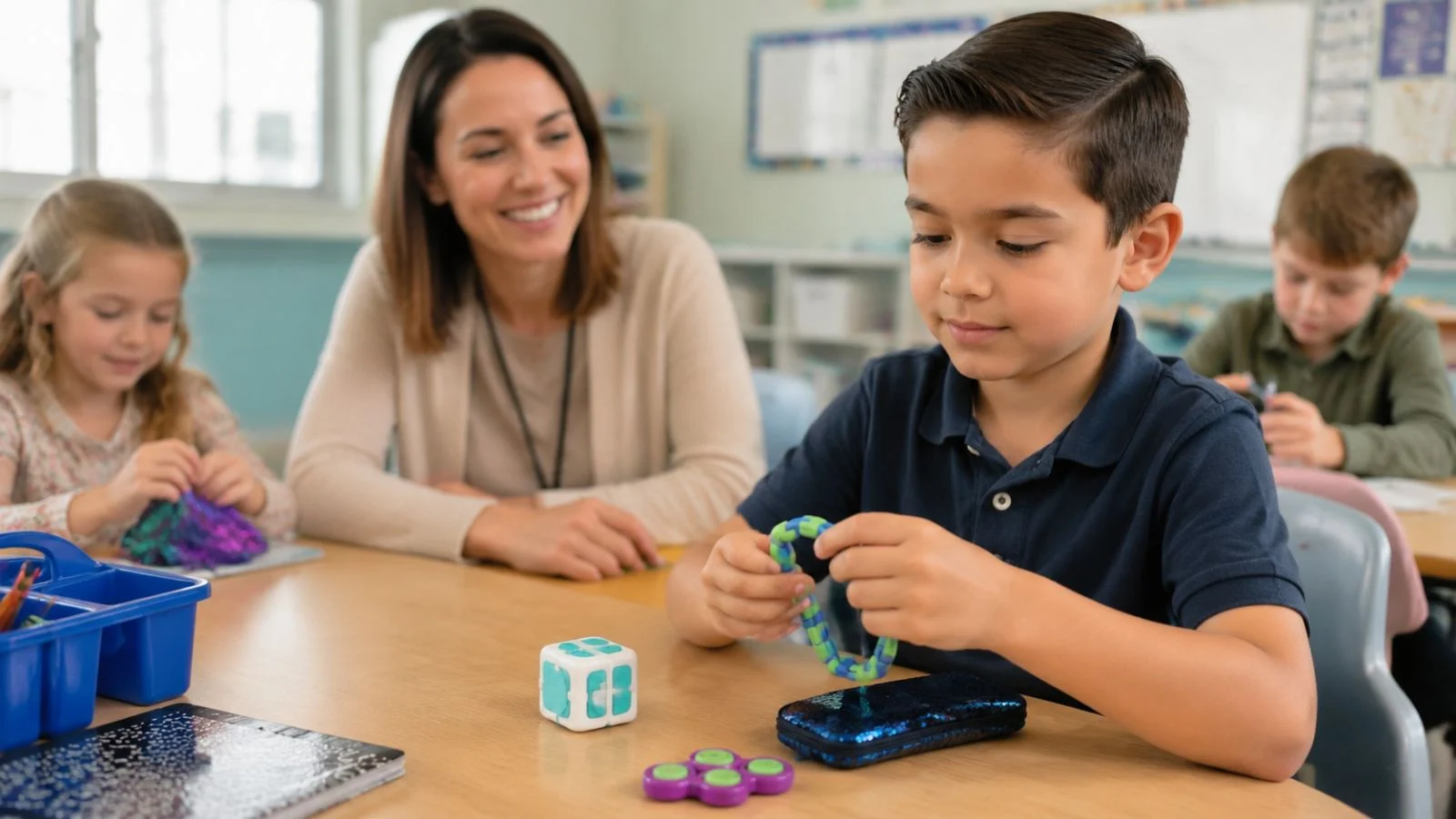
You know the moment. Your child is deep in a math worksheet at the kitchen table, pencil in one hand, the other hand pulling apart a pen, folding a napkin, tapping the chair leg. They’re not misbehaving. They’re working. That restless hand is helping their brain stay in the game.
But then the teacher emails you. “He keeps clicking things during quiet reading.” Or, “She’s distracting the table with her putty.” You feel your stomach drop. You know the fidgeting helps. The teacher knows it’s disrupting the room. Neither of you is wrong.
That tension is real. A UC Davis study found that children with ADHD who moved more during a cognitively demanding task actually showed better attention and cognitive control, not worse (Hartanto, Krafft, Iosif & Schweitzer, UC Davis MIND Institute, Child Neuropsychology, 2015). The study measured movement itself, not classroom disruption, but the takeaway for a teacher managing 27 other kids lines up: the fidgeting isn’t the enemy of focus. So the goal isn’t to stop the fidgeting. The goal is to channel it so it stays in the child’s hands and out of their neighbor’s eyeline.
One thing up front. Fidget toys can genuinely support focus and self-regulation for kids with ADHD. But they are a tool, not a treatment. If your child is struggling to keep up, melting down after school, or feeling bad about themselves in the classroom, talk to their pediatrician, school counselor, or an occupational therapist. The right supports (sometimes therapy, sometimes medication, sometimes just a better seating plan) matter far more than the right toy.
Why fidgeting helps ADHD brains focus
Here’s what’s actually happening in your child’s head when they fidget.
The ADHD brain has a harder time keeping dopamine (the “pay attention, this matters” chemical) at steady levels. Ritual small movements quietly raise arousal and refill the tank, so to speak. The brain gets the signal it needs to stay on task without having to misbehave to get it.
If you want the deep dive on sensory input and why specific textures, weights, and movements land differently for ADHD kids, our What Are Sensory Toys? guide walks through it: what feedback each sense provides and why that matters for regulation.
The short version for classroom purposes: movement is not the enemy of focus. The right kind of small, controlled movement is a focus aid. The wrong kind (loud, flashy, designed to be looked at) is a desk toy that derails the whole table.
The rule that decides everything: quiet and out of sight
Before the categories, one principle. Every teacher I’ve ever asked said the same thing in different words:
“The fidget itself isn’t the problem. It’s whether my other 27 students can hear it or feel compelled to look at it.”
That gives us a simple two-rule filter for anything that goes to school:
- No sound, or so subtle a kid three seats away can’t hear it.
- No eyeball magnet: stays in the lap or under the desk, not launched across the room or passed around.
A toy that fails either test will get taken away within a week, no matter how good the intention behind it. A toy that passes both gets to stay and keep doing its job. Everything below is sorted by how well it clears that bar.
6 types of classroom-friendly fidgets (ranked by teacher tolerance)
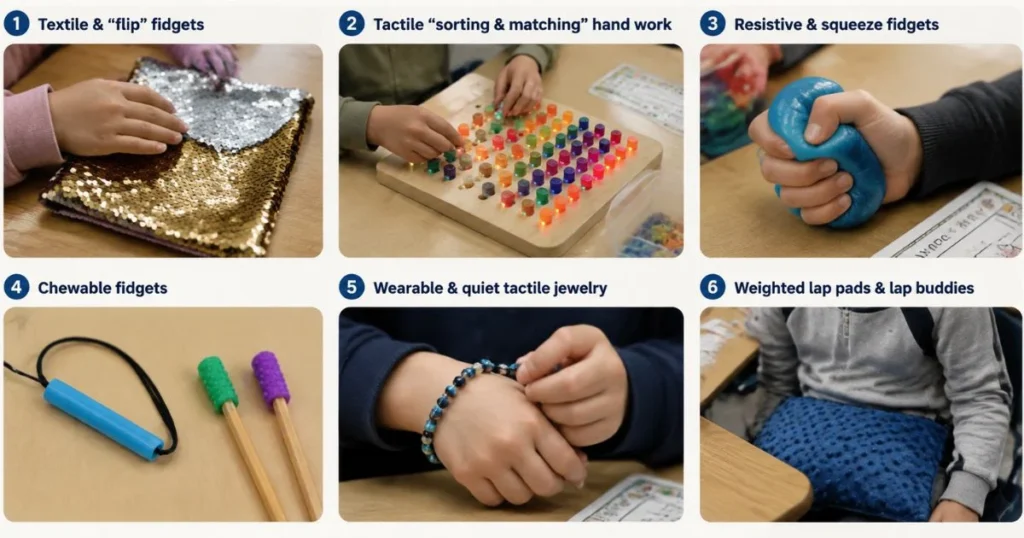
1. Textile & “flip” fidgets (the gold standard)
Sequin fabric, velour, satiny edges of a comfort item. The motion is running a thumb across a changing texture, flipping sequins from one color to another. Silent, self-contained, and self-regulating in the truest sense. The attention stays on it.
Our Reversible Sequin Fabric is the classroom staple of this category. One side silver, flip it and it’s gold. A child can sit with it flat on their lap, flip sequins through a math block, and the kid beside them never knows. It’s the one I send to school without a second thought.
2. Tactile “sorting & matching” hand work
These sit in a gray zone: not a pure fidget, not a full lesson. Think peg boards, bead mazes, color sorting trays. The hands are busy with a real, finished-thing task, which is exactly the kind of “productive” fidget teachers warm to. The child isn’t just squishing; they’re completing small satisfying loops.
I’ve had teachers specifically request the Light Up Peg Board Mini as a calm-desk activity for wiggly kids; it’s small enough to live on a corner of the desk, the pegs click softly into place, and the motion of pushing each one in is the kind of repetitive focus work that doesn’t compete with the lesson. For younger kids or quieter table time, the Montessori Color Sorting Toy works the same way: sort, place, repeat. (We get into why this “hands doing a job” approach suits ADHD kids so well in our Is Montessori Good for ADHD? post.)
3. Resistive & squeeze fidgets
Therapy putty, stress balls, stretchy bracelets. The motion is pressing, squeezing, pulling against resistance. Deep, heavy input to the hands, the kind of pressure that helps a wound-up kid come down a notch. Silent, and almost impossible to turn into a spectacle.
The catch: these can become projectiles if your child is a thrower. If that’s a known issue at school, skip the ball-shaped ones and go for a flat putty in a small tin that stays on the desk.
4. Chewable fidgets (for the kids who mouth everything)
Some kids focus through their mouth: pencil tops gnawed to splinters, shirt collars stretched out, sleeves damp by recess. For those kids, a silicone “chewelry” pendant or a chewy pencil topper placed where the teeth can find it gives the jaw something to do besides destroy school supplies.
Two cautions here. First, these are a hygiene item; get two and rotate them. Second, talk to the teacher so it’s framed as a focus tool, not a “baby thing.” Older kids especially will not use one if they think it looks childish.
5. Wearable & quiet tactile jewelry
Spinner rings, beaded bracelets, a loop of cord a child can twist on a finger. These never leave the body, which makes them nearly confisc-proof. A subtle beaded bracelet a child can roll between their thumb and finger is one of the smartest classroom fidgets there is: always there, never a noise, never a disruption.
6. Weighted lap pads & lap buddies
Not a fidget in the motion sense, but a top-tier classroom tool for the ADHD kid who fidgets because they can’t feel where their body is (proprioceptive seekers). A small weighted pad across the lap during desk time gives steady, calming input that keeps a wriggly body seated longer. No moving parts, no noise, no show.
How to talk to the teacher (without making it weird)
This is the part a lot of parents skip, and it’s why perfectly good fidgets end up in the teacher’s desk drawer by Friday.
You don’t need a meeting. You need a two-minute conversation and a follow-up email. The script below has worked for me more than once. The goal is to show the teacher you know their classroom reality, you have a specific plan, and you’re inviting them to be part of it.
The opener (say this in person or on the phone)
“I know [Child’s name] fidgets a lot during seat work, and I know it’s been a distraction. I’ve found a couple of quiet tools that help them focus without bothering the table. Would you be open to trying one for a week and seeing if it’s better for everyone?”
Notice what this does. You named the problem first. You said you have a plan. You asked for the teacher’s read, not permission to override them. Teachers are teachers; they respond well to “partner with me.”
The follow-up email (send the same day)
Keep it short. Here’s a template:
Hi [Teacher],
Thanks for chatting about [Child]’s fidgeting today. As mentioned, I’d like to send in one quiet tool (a reversible sequin strip) for them to use in their lap during seat work. It makes no sound and stays off the desk.
If it becomes a distraction, please take it and let me know. I’d rather hear that than have it become an issue. If after a week you feel it’s helping, we can keep it in their pencil case.
Appreciate everything you do,
[You]
Three things make that email land. You picked a quiet tool, not a flashy one. You gave the teacher explicit permission to remove it. And you named a review point (a week), so it’s a trial, not a decree.
If your child has an IEP or 504 plan
Fidget tools can be written into an IEP or 504 as a classroom accommodation. If your child already has a plan, bring this up at the next review meeting: “We’d like quiet fidget access written in as an accommodation, and here’s the specific one with a review date.” Putting it in writing means it doesn’t depend on a single teacher’s goodwill. A specific item named in the plan also makes confiscation a process issue, not a “bad day” issue.
If your child does not have a plan and the fidget conversation is your first hint their classroom needs are bigger than a toy; talk to the school counselor about whether an evaluation makes sense. Don’t power through alone for months because a sequin strip is “working.”
Setting up a calm corner in the classroom
More and more classrooms (especially in the early grades) now have a designated “calm corner” or “reset space”: a small spot where any child who’s getting dysregulated can go for two to five minutes before returning to the group. For ADHD kids who feel the room closing in on them during a long afternoon, this can be the difference between a meltdown and a reset.
If your child’s teacher is open to it (many are; it’s less work for them than repeated disruptions), offering to help stock the calm corner is one of the most genuinely useful things a parent can do. A few quiet, non-electronic items that any child can use:
- A small weighted lap pad
- A pot of therapy putty
- A tactile fabric square (the Reversible Sequin Fabric works here too)
- A visual focus point on the wall, a slow, soft glowing panel a child can rest their eyes on while they breathe (sensory wall panels are built for exactly this)
That last one is why I love seeing the Light Up Sensory Wall Panel in classroom calm corners. It mounts on the wall (not the desk, so it’s not a personal fidget competing for attention), glows softly through color shifts, and gives a child’s eyes somewhere calm to land during a reset. It’s a shared-space tool, not a desk toy, which is a meaningful distinction for a teacher managing a whole room.
For the full list of what belongs in a calm corner, plus classroom rules and a postable script, see our Calm Corner Setup Checklist.
What NOT to bring to class (the confiscated list)
Save everyone a week of frustration. These will get taken:
- Loud or clicky fidget spinners. The original spinners were plastic bearings that whirred and clicked. Any spinner that makes noise is gone by Tuesday.
- Bright, flashing light-up desk toys. If it blinks, it’s a light show. A calm corner panel mounted on the wall is different; a handheld strobing fidget is a disruption, full stop.
- Fidget cubes with clicky buttons and switches. Quiet cubes exist, but most are clicky. The pen-click the teacher already hates is the sound a fidget cube makes, multiplied.
- Sticky things that pick up lint. A sticky toy that gathers dirt and hair isn’t a fidget; it’s a hygiene complaint waiting to happen.
- Things designed to be thrown, launched, or popped. This includes pop tubes you can pull apart and spring across the room. They’re great at home. Not at school.
As a general principle: if the toy’s appeal is “look what it does!” it’s not a classroom fidget. If its appeal is “feel this while you work,” it probably is. That one sentence will save you a lot of emails.
Frequently asked questions
Do fidget toys actually help kids with ADHD, or are they just a trend?
They help, within limits. A UC Davis study measuring real movement in kids with ADHD during a cognitive task found that more movement was linked to better attention and cognitive control, not worse. What the research doesn’t tell us is which specific toy works for which specific kid; that part is still trial and error. So the honest claim isn’t “fidgets work, period.” It’s “movement itself seems to help ADHD brains focus, and a good fidget toy is one quiet way to get it without derailing the room.” That’s a more useful claim than either the hype or the backlash.
My child’s teacher banned all fidgets. What do I do?
Ask why. Usually it’s because a previous child used something loud or disruptive, and the teacher made a blanket rule. Bringing a genuinely silent, non-visual option (like a fabric strip or a wearable ring) and framing it as a trial often opens the door. If your child has an IEP or 504, you can also request fidget access as a formal accommodation. Sometimes, though, a particular teacher’s rule is firm, and the more productive path is working with the school counselor or case manager to find another regulation strategy that fits that classroom.
At what age should I stop sending fidgets to school?
There’s no hard age: middle schoolers and even high schoolers use quiet fidgets, and many adults do too. What changes is what’s socially tolerable. A fabric strip in a pencil case is age-invisible. A bright sensory toy is not. Let your child help choose as they get older, because the fidget that works is the one they’ll actually use, not the one you picked that sits unused in their locker.
Can fidget toys replace ADHD medication or therapy?
No. Fidgets are a regulation tool, the same way glasses are a vision tool. They help your child function in a setting that’s hard for them. They don’t change the underlying wiring. If your child’s pediatrician or therapist has recommended medication, behavioral therapy, or an OT evaluation, a fidget supports that plan; it doesn’t replace it. The right way to think about it: therapy and treatment address the cause; fidgets make the classroom more livable while that work happens.
The bottom line
A good classroom fidget is a quiet, boring-looking object that lives in your child’s hands or lap, makes no sound, and never makes another kid look up from their work. That’s the whole bar. If a toy clears it, it’s probably classroom-safe; if it doesn’t, no email to the teacher will save it.
The teacher scripts and the calm corner are where the real change happens, though. The toy alone is just an object; the conversation around it is what turns it into an accommodation that lasts the year. My experience: most teachers are far more receptive than you expect when you bring a quiet tool, name the problem ahead of time, and give them permission to remove it. You’re not asking them to take on more; you’re offering one less disruption to manage.
If you want to think bigger-picture about how hands-on, purposeful activities suit ADHD kids beyond just the fidget, our Is Montessori Good for ADHD? and Montessori Toys for 2 Year Olds guides are good next reads. And if you’re new to what sensory input actually does for regulation, What Are Sensory Toys? is the place to start.
Whatever you send to school on Monday, try one thing at a time, give it a real week, and trust what your child (and their teacher) tell you. That’s the only test that actually matters.
Moni
MoniBabu founder. Test-drives every toy with real families before it lands on this site.