
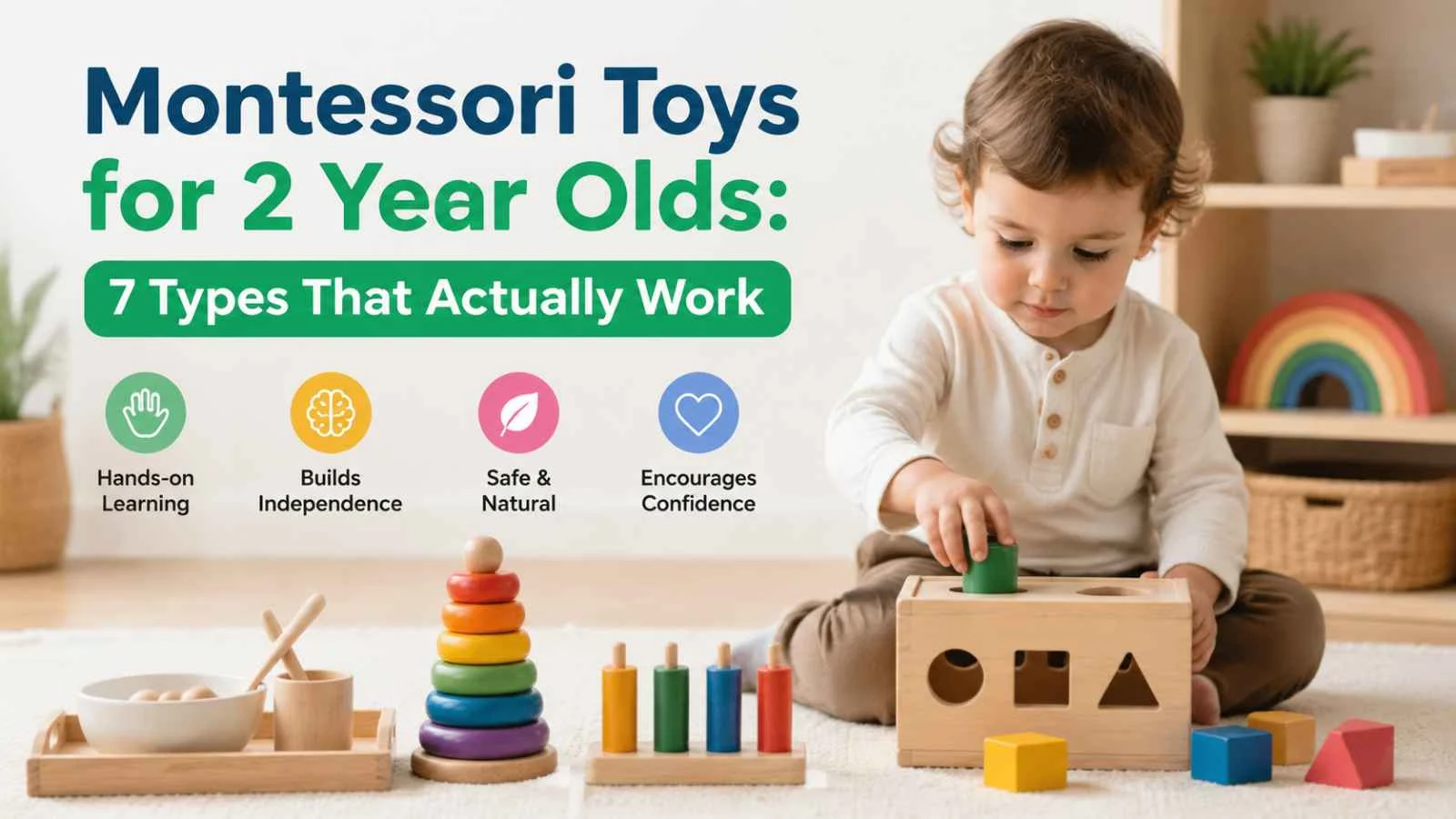
The best Montessori toys for 2 year olds are simple, made of natural materials, and built around one clear skill: sorting, stacking, pouring, or fitting shapes. No batteries, no flashing lights, no 400 plastic pieces. A good Montessori toy hands the job to the child and then gets out of the way.
That sounds easy until you’re standing in a toy aisle at 9pm holding two things that both say “Montessori” on the box. One is a plain wooden board. One has a cartoon character and a speaker. Which is the real deal? This is the guide we wish we’d had. We’ll walk through the 7 types of Montessori toys for 2 year olds that actually get played with, why each one matters, and how to pick without overspending.
Table of Contents
What makes a good Montessori toy for a 2 year old?
Two year olds are little scientists. They test gravity by dropping your phone. They sort the laundry into piles you didn’t ask for. Montessori toys just point that energy somewhere useful. A few things separate a real one from a marketing sticker:
- One main purpose. The child masters a single skill instead of getting pulled ten directions.
- Natural materials. Wood, cotton, metal. They feel better in the hand and take a beating.
- Child-led. No “press here and I’ll do it for you.” The kid does the work and feels the win.
- Real, not pretend-electronic. A toy that pours real water beats a screen that shows water every time.
The wider idea comes from Maria Montessori’s method, and groups like the National Association for the Education of Young Children back the same principle: young kids learn by doing, with their hands, at their own pace.
The 7 types of Montessori toys for 2 year olds
1. Color sorting and peg toys (our top pick)

If we could only buy one, it’d be a color sorting peg board. It hits three things a 2 year old needs at once: the pincer grasp (thumb and finger, the grip they’ll use to hold a pencil), color recognition, and early counting. Our Montessori Color Sorting Toy is a natural wood board with 49 smooth rainbow pegs, non-toxic paint, a drawstring pouch, and 5 starter activity cards. At $29.99 it’s the one toy in our house that survived a full year of daily use. Toddlers stack the pegs, sort by color, count them into the pouch, and dump them out to start over.
2. Practical life toys
This is the Montessori secret weapon. Two year olds are desperate to do “real” jobs: pouring, scooping, wiping, buttoning. A small pitcher and two cups for pouring water at the table will hold a toddler’s focus longer than most toys on the shelf. It builds coordination and independence, and it feels important to them because it is.
3. Stacking and nesting toys
Wooden rings on a post, nesting cups, simple stacking blocks. These teach size order, balance, and cause and effect. When the tower falls, that’s the lesson, not a failure. Look for solid wood over hollow plastic. It stacks straighter and lasts.
4. Shape sorters and simple puzzles
A 2 year old is ready for shape sorters and puzzles with 3 to 5 big pieces and little knobs. The knobs, again, train that pincer grasp. Start easy. A puzzle that’s too hard gets thrown, and a thrown puzzle teaches nothing.
5. Fine motor and threading toys
Threading big wooden beads onto a lace, posting coins into a slot, pushing pegs into holes. All of it strengthens the small hand muscles behind writing, zipping, and self-feeding. The peg board in pick number 1 doubles as a threading and posting toy, which is part of why it earns its keep.
6. Gross motor toys
Montessori isn’t only tabletop. A balance board, a low climbing setup, or a simple push wagon lets a 2 year old build the big-muscle coordination that actually helps them sit and focus later. Movement first, focus second. Ask any occupational therapist.
7. Open-ended sensory toys
Montessori and sensory play overlap a lot at this age. Toys with texture, weight, or gentle light give a 2 year old room to explore without a “correct” outcome. If you want the full breakdown, we cover it in our guide to what sensory toys are and which ones fit which kid.
Montessori toys by age: 1, 2 and 3 year olds
The line between ages is blurry, but here’s roughly how it shifts:
- 1 year old: big, chunky, mouth-safe. Object permanence boxes, simple stackers, balls. They’re mostly grabbing, dropping, and mouthing. Our sensory toys for 1 year olds guide goes deeper on this stage.
- 2 year old: the sweet spot for sorting, pouring, and 3 to 5 piece puzzles. Their hands are ready for real fine motor work. This is where a color sorting board shines.
- 3 year old: more steps, more independence. Lacing cards, harder puzzles, matching games, early practical life like pouring their own snack. A good 2 year old toy usually grows with them into age 3, which is what you want for the money.
How to choose Montessori toys for a 2 year old (without wasting money)

- Buy one skill at a time. Watch what your toddler is obsessed with this month (stacking? pouring? sorting?) and buy into that.
- Pick wood and cloth over plastic. It lasts, resells, and feels better.
- Check for small parts if your child still mouths things. The AAP toy safety guide is worth the five minutes.
- Choose open-ended. A toy with one trick is boring by Friday. A sorting board has a hundred games in it.
- Rotate, don’t pile. Keep 4 or 5 toys out and store the rest. Fewer choices, deeper play.
Start with the Montessori Color Sorting Toy and add from there. It ships free in the US with 30-day returns, so it’s a low-risk first buy. Browse the rest in the MoniBabu shop.
Montessori toys vs regular plastic toys: what actually changes
Parents often ask if the Montessori label is just marketing. Fair question. The honest difference is not the wood or the price tag, it is what the toy asks the child to do. A regular light-and-sound plastic toy does the entertaining for the child. Press a button, it sings, the child watches. A Montessori toy for a 2 year old flips that: the child does the work, and the reward is finishing the job themselves. That shift matters more than it sounds. Child-led toys build focus and independence because the toddler is the one making things happen. They also tend to hold attention far longer, since there is always a next attempt, a new pattern, a harder version of the same task. And because good Montessori toys isolate one skill, a flooded or tired toddler is not bombarded by ten flashing features at once. None of this means you throw out every plastic toy in the house. It means when you are choosing the next one, ask a simple question: does this toy do the playing, or does my child? For a 2 year old, the ones that hand over the work usually win.
Best Montessori Toys for 2 Year Olds — Our Top Picks
If you’re short on time and just want to know which specific toys are worth the money, here are the five we’d buy for our own two-year-olds. Each one hits a different developmental skill, they’re all made of solid wood with non-toxic finishes, and they’ve all survived the “throw it, drop it, step on it” test.
| Toy | Skill | Why It’s Worth It | Price | Buy |
|---|---|---|---|---|
| MoniBabu Color Sorting Toy | Fine motor & color recognition | 49 pegs, 7 colors, grows from 12 months to 3+ years | $29.99 | Shop |
| MoniBabu Light Up Peg Board Mini | Visual tracking & cause-effect | 30x30cm tabletop, quiet LED, no app/screen needed | $262.99 | Shop |
| Reversible Sequin Fabric | Tactile regulation | Flip sequins change color — calm, silent, travel-friendly | $24.99/yd | Shop |
| Mess Free Water Coloring Book | Creative fine motor | Paint with water, zero mess, 16 scenes, 2 pens | $15.99 | Shop |
| Light Up Sensory Wall Panel | Proprioceptive & visual calm | 60x60cm wall mount, 175 pegs, remote-controlled | $459.00 | Shop |
Price check: all prices current as of August 2026. We only sell what we’ve tested with real families. Free US shipping on everything, 30-day returns.
Not sure where to start? If your two-year-old is still mostly dumping and mouthing, grab the Color Sorting Toy and the Water Coloring Book — they’re the two we see parents reorder most. If you’re setting up a dedicated play corner, the Light Up Peg Board Mini is the best bang-for-buck visual anchor. And if you want the full calm-corner centerpiece, the Sensory Wall Panel is the one that makes other parents ask “where did you get that?”
id=”the-bottom-line-on-montessori-toys-for-2-year-olds” class=”wp-block-heading”>The bottom line on Montessori toys for 2 year olds
You do not need a shelf full of expensive wooden toys to give your 2 year old a great Montessori start. Pick one toy that matches what your toddler is obsessed with this month, choose natural materials over plastic, and let them do the work. A color sorting peg board is our first recommendation because it grows from age 2 well into age 3 and covers fine motor skills, color, and counting in a single quiet activity. Add a second toy only once the first is a proven hit. Fewer, better, rotated often. That is the whole method in one line, and it will save you money and clutter while your toddler actually plays longer.
Montessori toys for 2 year olds: quick answers
What are the best Montessori toys for 2 year olds?
The best Montessori toys for 2 year olds focus on one hands-on skill and use natural materials: color sorting and peg boards, practical-life pouring sets, stacking and nesting toys, chunky shape sorters, and threading toys. A color sorting peg board is a strong first pick because it covers fine motor skills, color, and counting in one.
Are Montessori toys really better for 2 year olds?
They’re not magic, but the principle holds up: child-led, single-purpose, natural-material toys keep a 2 year old’s attention longer and build real skills like the pincer grasp. Many parents find their toddler plays with one good wooden toy far longer than with a pile of plastic ones.
How many toys should a 2 year old have out at once?
Fewer than you think. Four or five well-chosen toys on an open shelf, with the rest stored and rotated every week or two, usually leads to deeper, calmer play than a full toy box.
What is the difference between Montessori and sensory toys?
Montessori toys are child-led and skill-focused, often around practical life and fine motor work. Sensory toys target the senses (sight, touch, movement) for regulation and calm. They overlap a lot at age 2, and many toys, like a color sorting board, count as both.
MoniBabu is a family-run US store making therapist-inspired toys for toddlers and kids with sensory needs. Not sure what fits your 2 year old? Message us, a real parent answers.