
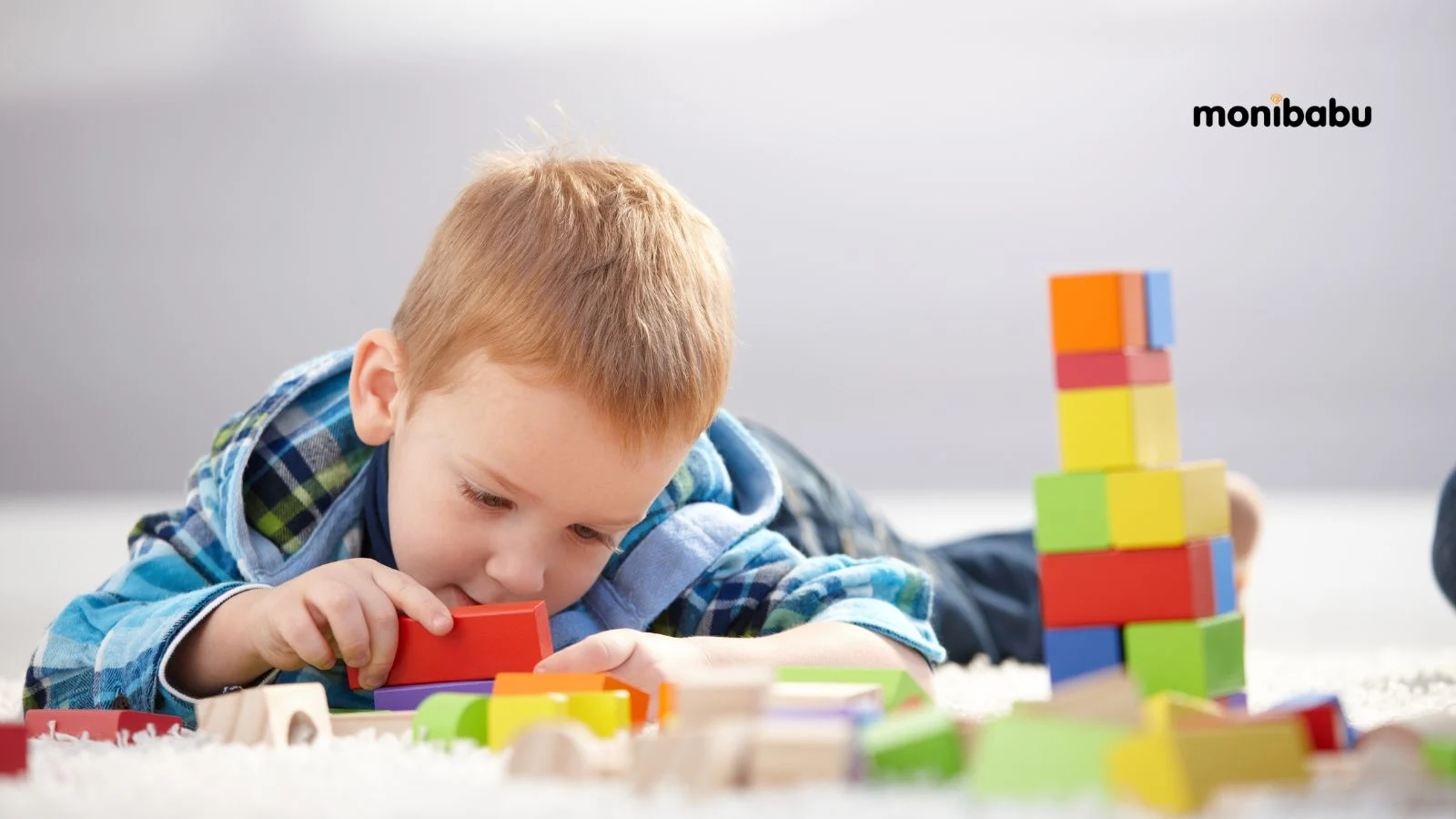
If you’re reading this at 11pm with one eye open, I see you. Maybe your one-year-old just dumped an entire toy basket on the floor and ignored every single thing in it. Or maybe you’re staring at a checkout cart full of “sensory” stuff and wondering whether any of it actually does anything.
You’re not overthinking it. The first birthday is when a lot of parents start asking real questions about development, what’s normal, what’s not, and what’s just marketing dressed up in pastel packaging. And the toy market is loud. Every box says “sensory” now. The word has lost most of its meaning.
So here’s the honest version. I’ve spent the last few years testing sensory toys for 1 year olds with my own kids and the kids in our MoniBabu community. I’ve seen what gets played with past day two and what ends up under the couch by Thursday. This guide cuts through that.
We’ll walk through what sensory play actually looks like at 12-18 months, the five types of sensory toys that genuinely help, the safety rules nobody tells you until it matters, and how to introduce this stuff without making your living room look like a therapy clinic. If you’re new to what sensory toys even are, our what are sensory toys guide breaks it down across age groups, a good place to start before picking something specific.
One thing up front: sensory toys support regulation, focus, and development. They are not a substitute for professional therapy. If you have concerns about your child’s development (milestones, behavior, eating, anything), talk to your pediatrician. Toys are tools. They aren’t treatment.
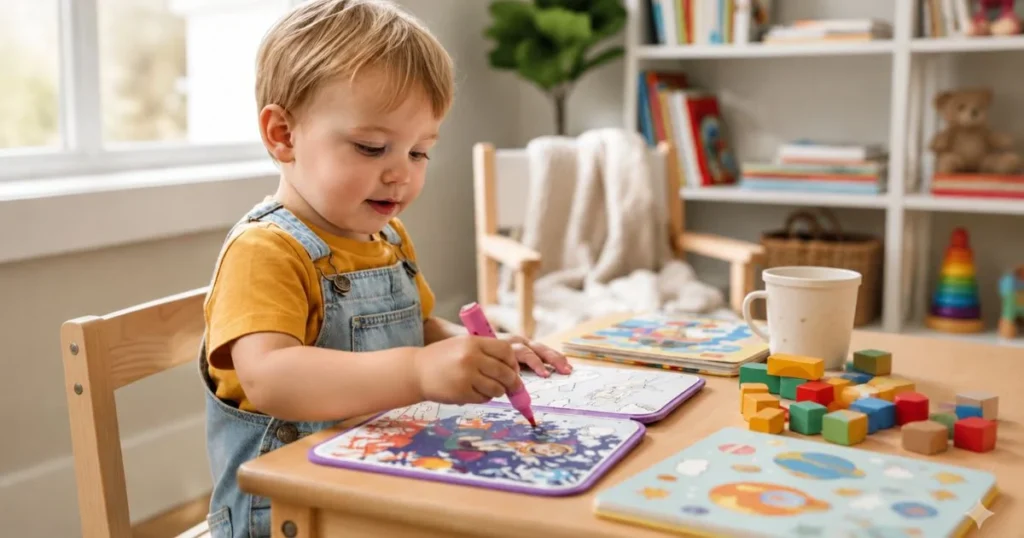
What sensory play looks like at 12-18 months
Here’s the part most guides skip: sensory play at this age doesn’t look like “play” the way you imagined it. It looks like dumping, dropping, mouthing, and repeating the same motion forty times until you wonder if something is wrong. Nothing is wrong. That is the work.
Between 12 and 18 months, your child is in the middle of what developmental experts call the sensorimotor stage. They’re learning how the world works by physically testing everything. What happens if I push this? What happens if I let go? Does this thing still exist when I can’t see it?
Three things are firing at once:
- Pincer grasp. Around 9-12 months most kids start picking up small objects between thumb and index finger. By 15 months they’re refining it, grabbing peas, pulling tags, turning pegs. This is handwriting, buttoning, and self-feeding in embryo form.
- Cause and effect. Drop the spoon, mom picks it up. Drop it again. This isn’t mischief or bad behavior; it’s a baby physicist testing gravity and social loops. Cause-and-effect toys (pop buttons, levers, lights that switch on) feed this directly.
- Object permanence. At 12-18 months they’re solidifying the idea that things still exist when you hide them. Peek-a-boo stops being scary and starts being funny. Hiding toys under a blanket and finding them is a full activity, not a time-killer.
So when you see your one-year-old ignore a beautiful toy and spend twenty minutes putting one block in a bowl and taking it out, that’s not a fail. Their brain is doing something important. The right sensory toy gives that instinct somewhere to land.
5 types of sensory toys that help 1-year-olds
There are a hundred “sensory” categories online. Most of them overlap, and half of them are invented for marketing. Here are the five that actually matter at this age, what they do, and what a good one looks like. I’ll point you to the ones we make at MoniBabu where they fit naturally, not because they’re the only option, but because I designed them for exactly these milestones and tested them with real one-year-olds before selling them.
1. Visual stimulation toys
Visual sensory toys give a child something worth looking at and tracking: high contrast, gentle light, movement. At one year old this isn’t about flash and noise (please skip the loud flashing things). It’s about giving the eyes something steady and interesting to land on. Especially for kids who get dysregulated by bright chaotic rooms, a small controlled visual focus point can be calming.
The MoniBabu Light Up Peg Board Mini is what I made for this. It’s a 30x30cm tabletop LED peg board. You push pegs into slots and each one lights up. No screens, no app, no volume knob. A one-year-old won’t “play” it correctly; they’ll push a couple pegs, watch the light come on, lose interest, come back. That cycle is exactly what you want. It’s also a cause-and-effect loop in disguise: push the thing, the thing lights up.
Look for: steady soft light (not strobing), no small loose parts, a size that fits on a highchair tray. Skip anything that requires an app or charges via a weird proprietary cable.
2. Fine motor and grasping toys
This is the big one for the pincer grasp window. A year-old hand is learning to pinch, pull, and release. The right toy gives that small hand something rewarding to grab, not too fiddly, not too easy. Wooden pegs, rings, knobs. You want pieces large enough to hold but small enough to require deliberate finger positioning.
The MoniBabu Montessori Color Sorting Toy is the one I kept coming back to. It’s a wooden peg board with 49 wooden rainbow pegs. At one year old your child will not sort by color. Let that go. What they will do is pull pegs out, hold them, attempt to push them back, drop them, try again. That in-and-out repetition is fine motor work. Color sorting starts to click later, closer to 18-24 months, so this toy grows with them. If you want to see where this goes next, our Montessori toys for 2 year olds guide picks up exactly where this leaves off.
Look for: solid wood pieces (no splinters, no paint that chips when mouthing happens, and mouthing will happen), pieces at least 1.25 inches across so they can’t fully enter a child’s throat, smooth peg tops that won’t snap off. Skip anything with magnets or button batteries at this age.
3. Tactile and texture toys
Tactile toys are about touch: rough, smooth, soft, bumpy, flip. The reason this matters at one is underrated: a lot of kids with sensory sensitivities show the first signs right here. Some one-year-olds hate tags and seams. Some will stroke one specific blanket for an hour. Some avoid finger-paint like it’s lava. Tactile play doesn’t force tolerance, but giving a child varied, low-stakes textures to explore on their own terms builds comfort with touch.
Our Reversible Sequin Fabric (sold by the yard so you can cut it to whatever size you need) is the one I recommend for this window. Each sequin flips between two colors when you run a hand over it. The feedback is instant: stroke it, watch it change. For a one-year-old that’s tactile cause-and-effect. For an older kid who needs a regulation strategy it becomes a calm-down tool that lives on a fidget strip or a corner of a blanket. You’re not buying two products, you’re buying one that grows through several uses.
Look for: fabric you can wash, sequins or beads that are firmly attached (tug-test everything before handing it over), no loose threads a curious finger could pull into a long strangling length. Cut raw edges with pinking shears or hem them.
If tactile sensitivity is something you’re actively watching (a quiet sensitivity to tags, seams, sock seams, food textures), tactile play is one piece of the puzzle. Worth noting it connects to things many parents don’t expect; if that resonates, our piece on whether Montessori works for ADHD and related sensory profiles goes deeper on environment-by-environment regulation.
4. Mess-free creative play
One-year-olds are not doing art in any recognizable sense. They are doing cause-and-effect-with-color: “I made a mark. It went somewhere. It is mine.” That stage is real and it’s worth feeding. The problem is paint, markers, and crayons at this age mean you spend more time scrubbing walls than the kid spends scribbling. So most parents avoid the whole category. Then the kid misses the window.
This is where water reveal books win. The MoniBabu Mess Free Water Coloring Book works with a refillable water pen: you fill the pen, your kid “paints,” the pages reveal color, and everything dries back to blank in a few minutes. Zero paint, zero markers, zero clean-up. A one-year-old mostly makes marks that disappear fast, and that’s fine. The point is that they’re doing independent, low-pressure fine motor work while you load the dishwasher without redirecting them every 90 seconds. I carry one in the diaper bag for planes and restaurants.
Look for: refill pen included, pages that don’t peel off when mouthing happens, and a size small enough to fit a highchair or car seat tray.
5. Proprioceptive and movement toys
One-year-olds are becoming mobile: cruising, walking, climbing on anything you forgot to move. Proprioceptive toys give that need a home: things they can push, pull, carry, stack, knock over, and shove. Heavy for the size, satisfying to handle.
You don’t need to buy anything fancy here. Often the best proprioceptive toy at this age is a soft-block tower you build and they demolish, a low sturdy push wagon they can lean on while walking, or a weighted lap pad for floor time. The “sensory” framing gets overcomplicated. What you’re really doing is letting little muscles do real work, which is regulating for a body that’s suddenly in motion all day.
Look for: anything they have to actively move (not just watch), no hard corners at toddler-head height, stable bases that don’t tip when leaned on. Skip ride-on toys with narrow wheelbases at this age.
Safety rules every parent needs to know
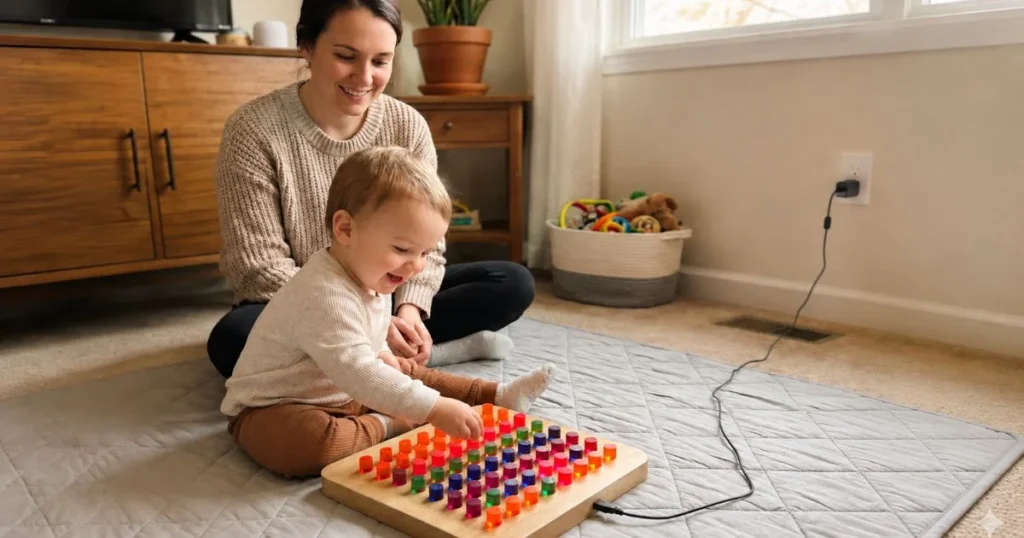
I’m going to be blunt about this because the stakes are too high to be polite. The Consumer Product Safety Commission bans toys with small parts for children under three for one reason: kids keep choking on them. The cutoff is a small-parts cylinder roughly 1.25 inches in diameter. If any part of a toy, including a piece that could reasonably break off, fits inside that, it’s a choking hazard for a child under three. Not under one. Under three.
That’s the part a lot of parents miss. “My one-year-old is past putting things in their mouth” doesn’t matter. The recommendation extends to age three because mouthing behavior continues well past infancy, and one bad moment is enough. So the rule I use, and the rule I’d give you, is:
- The 1.25-inch test. If a piece can fit through a standard toilet paper roll tube, it’s too small for any child under three. Yes, that includes lots of “Montessori” peg toys marketed at one-year-olds. Pull them out, test them. If they fail the test, save those pieces for age three.
- Supervise, always. Sensory play at this age means an adult in the same room, eyes on the kid, phone not in hand. Sensory toys are not babysitters.
- No button batteries, no magnets. Not at this age. A swallowed button battery can cause severe internal damage in hours. Strong magnets can cause intestinal injuries. If a toy needs a battery, the compartment should be screwed shut.
- Check what the surface is finished with. Mouths will happen. Look for non-toxic, water-based finishes, food-grade silicone, solid wood. Skip anything that smells chemical-strong out of the box.
- Inspect for breakage weekly. Toys that looked fine at purchase develop cracks, loose pegs, and frayed seams. Toss or repair anything that could produce a small loose part.
If a toy’s recommended age on the box starts above your child’s developmental age, trust the box on this one. Even if your child is “advanced.” The age label is not about intelligence. It’s about what fits in a throat.
How to introduce sensory toys to a 1-year-old
Here’s the thing nobody tells you: the way you introduce a sensory toy matters more than which one you bought. A basket of twelve new things handed to a one-year-old at once will produce overwhelm and a tantrum. Two to three options, offered one at a time on a clean mat or tray, will produce actual engagement. Less, deliberately chosen, beats more every time.
- One at a time, not a bin dump. Put out one or two toys max. Rotate them out every few days. Novelty is a feature, not quantity.
- Sit with them, then step back. Spend two minutes showing how it works: push a peg, flip a sequin, fill the water pen, then stop. Hovering and correcting (“no, put it here”) is the fastest way to kill engagement. Let them figure out their own way even if it’s “wrong.”
- Pick timing around regulation, not just “playtime.” Sensory toys shine when a child needs to come down: after a busy outing, before nap, during the witching hour. They are not the toy for a fully wired-up version of your kid. Match the toy to the state.
- Build a small predictable routine. Same mat, same time of day, same low lighting. Predictable context makes a kid more willing to explore. If your child has autism or sensory processing differences, predictability is even more important; it lowers the cognitive cost of the activity.
- Follow the kid, not the marketing copy. If they spend 20 minutes pushing one peg in and out, that’s a win. Don’t redirect them toward “proper” use. The proper use at this age is whatever they’re doing with focused attention.
And please, put the phone down. Sensory play with a one-year-old is ten minutes max most of the time. You have ten minutes.
Frequently asked questions
Are sensory toys only for kids with autism or ADHD?
No. Sensory toys are for every child. Kids with autism, ADHD, or sensory processing differences often need them more, and benefit more visibly, but every one-year-old is building sensory systems at this age. Cause-and-effect, fine motor, texture tolerance, visual tracking. None of that is diagnosis-specific. The reason the conversation centers on neurodivergent kids is that the stakes are higher there, not because sensory play is a special-needs category.
How many sensory toys does a 1-year-old actually need?
Fewer than you think. Three to four quality toys that hit different senses (one visual, one fine motor, one tactile, one for movement) is more than enough if you rotate them. Twenty sensory toys in a bin is not a toolkit, it’s clutter that overwhelms the kid you bought it for. Pick a small set, use it well, and resist the urge to add more until something clearly stops engaging.
My 1-year-old ignores the toy I bought. What do I do?
Three things. First, try at a different time of day; tired or hungry kids don’t “play” anything, they melt down. Second, try with you doing the activity yourself for a minute and ignoring them; kids at this age want what they see you doing. Third, put it away for two weeks and reintroduce. Development happens in jumps; something uninteresting at 13 months can become the favorite at 15 months. None of this means you bought the wrong toy. It means one-year-olds are unpredictable, which is just what they are.
When should I talk to someone about my child’s development?
If you have a nagging worry (milestones not hitting, eye contact feeling different, your child seeming to live in their own world, regression in skills they used to have), talk to your pediatrician. A toy will not fix a developmental delay. Early intervention services, when they’re warranted, make a real difference, and they’re easier to access the earlier you ask. Asking is not overreacting. Pediatricians expect these questions. I wish someone had told me that earlier than they did.
The bottom line
Sensory toys for 1 year olds aren’t a magic key to brilliant development, and they’re not optional fluff. They’re a small set of well-chosen tools that give a year-old brain somewhere real to do the work it’s already trying to do: pinch, push, look, repeat. The right ones buy you both something: your kid gets genuine developmental play, and you get ten minutes where someone is happily occupied by something that isn’t your phone.
Here’s what I’d actually buy if I were starting over with a one-year-old today:
- One visual cause-and-effect toy: our Light Up Peg Board Mini does this in a small tabletop form.
- One fine motor peg toy: the Montessori Color Sorting Toy grows with them from 12 months into the 2-year-old stage.
- One mess-free creative option: the Mess Free Water Coloring Book for restaurants and travel.
- One tactile thing: a small cut of our Reversible Sequin Fabric to handle and watch change.
- One sturdy movement toy: anything they can push, carry, or knock over safely.
Five things. That’s enough. Less than five is also fine. What matters is that each one is safe, age-appropriate, actually gets used, and is paired with your full attention for the ten minutes it holds a one-year-old’s focus. The toy is not the thing. You and the kid, doing one thing together, is the thing.
If you want the bigger picture on what sensory toys are and why they’re not just a buzzword, start with our what are sensory toys guide. If your one-year-old is heading toward two, our Montessori toys for 2 year olds guide is the natural next read; a lot of the same toys carry over and keep working.